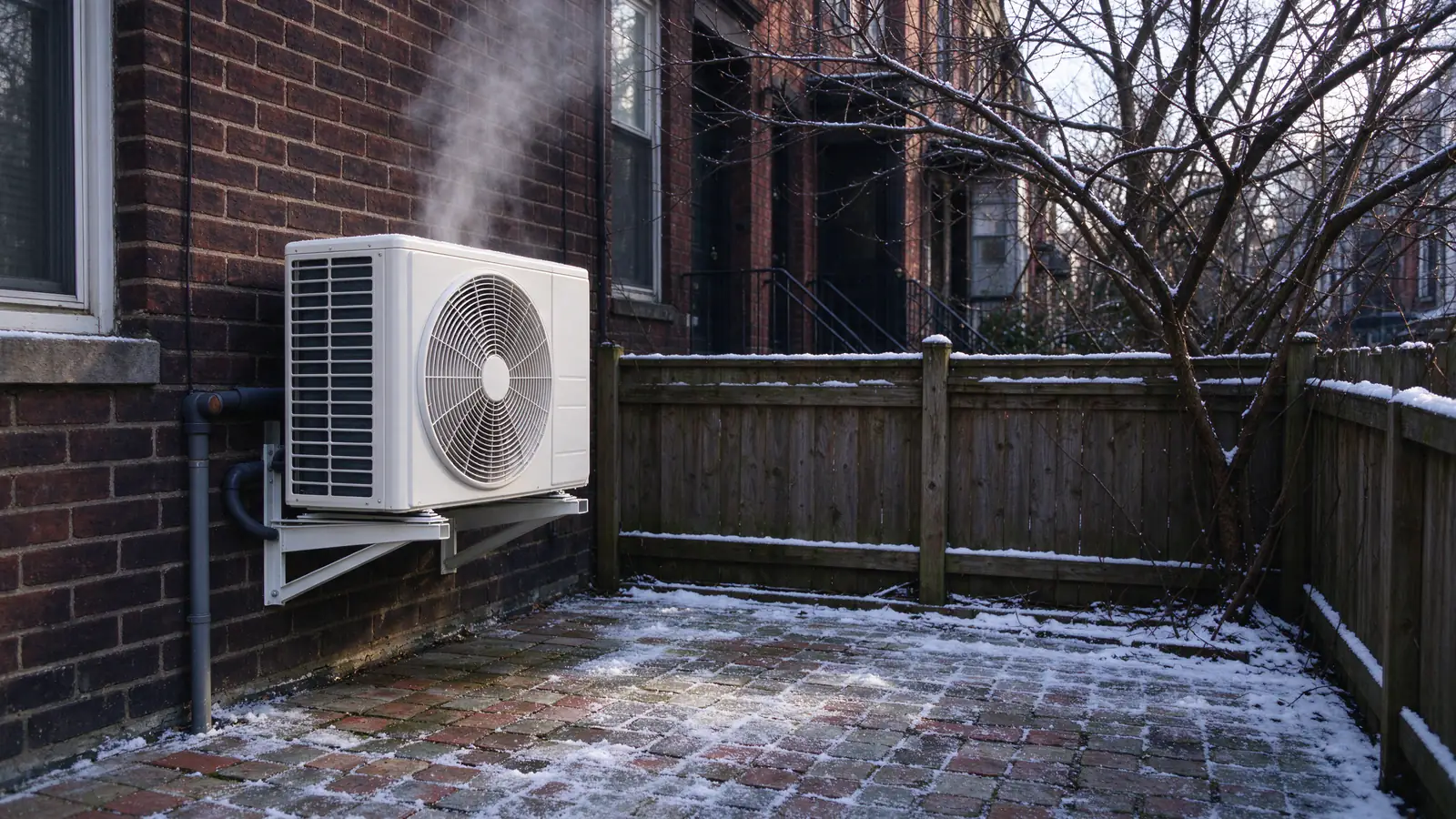
A mini split is a heat pump, and in Washington it can carry heat through the whole winter, not just the shoulder months. Roomwise DC Mini Splits sizes every head from a heat-load calculation at the District’s 21°F design temperature. Here’s how that works, and what to expect on the coldest days.
How cold does DC actually get?
Colder than people remember in July, but mild for a heat pump. January at Reagan National averages 37.5°F, with overnight lows around 30°F.
NOAA’s 1991 to 2020 normals at Reagan National show how rare the hard cold is:
| Winter measure at Reagan National | Average per year |
|---|---|
| Nights at or below 32°F | About 60 |
| Nights below 20°F | About 10 |
| Nights below 10°F | Less than one |
| Days with 1 inch or more of snow on the ground | About 10 |
| Days with 10 inches or more on the ground | About 1 |
The District’s heating design temperature, the cold day equipment is sized to handle, is 21°F. A system that meets the load at 21°F covers almost every hour of a DC winter.
How does a mini split make heat when it’s cold out?
It moves heat rather than making it. Outdoor air at 20°F still holds heat, and the refrigerant in the outdoor coil runs colder than that, so it absorbs heat from the air.
The compressor squeezes that refrigerant to a high pressure and temperature, and the indoor head releases the heat into the room. A reversing valve runs the same loop backward in summer to cool. As the outdoor air gets colder, there’s less heat to collect, so two things happen:
- Capacity drops. The unit delivers less heat per hour at 5°F than at 47°F.
- Efficiency drops. It uses more electricity for each unit of heat.
That’s why sizing to the design day matters, and why a heat pump’s cold-weather numbers matter more than its headline rating.
Do I need a cold-climate mini split in DC?
Not by label. “Cold climate” is a marketing term on many boxes; what counts is the certified capacity the unit delivers at low temperatures.
What to look at instead
- Rated heating capacity at 17°F and 5°F, from the manufacturer’s data or the ENERGY STAR listing
- Whether that capacity at 21°F covers the room’s heat loss, from the load calculation
- HSPF2, the seasonal heating efficiency; DCSEU’s rebate tiers start at 7.8 and rise to 9
A unit that holds most of its capacity at 5°F gives margin on the rare single-digit night. In DC, that margin is worth most on a whole-house plan where the boiler is retired. The sizing guide explains the load calculation.
Cooling-only models
Some mini splits cool only. They’re cheaper, but they do nothing in winter and don’t earn the DCSEU heat pump rebate. For heat in DC, choose a heat pump model.
Why does it stop and steam on a cold morning?
That’s a defrost cycle. Below about 40°F in damp weather, frost builds on the outdoor coil, and the unit briefly reverses to melt it.
During defrost, the indoor fan stops so it doesn’t blow cool air, and the outdoor unit may hiss and send up a cloud of steam. After a few minutes heating resumes. Frequent defrost on humid, near-freezing mornings is normal. The meltwater has to drain away from the unit; the condensate guide covers that.
Do mini splits have emergency heat?
Most wall heads don’t. Unlike a ducted heat pump with backup heat strips in the air handler, a ductless head has no built-in resistance heater.
So the backup is whatever else heats the house. In a DC radiator house there are three common plans:
- Keep the boiler as backup and let the mini splits carry most of the season.
- Keep electric baseboards in rooms that already have them, for the coldest nights.
- Size for the whole load with heads in every room and retire the old heat.
Which fits depends on the house, the equipment and how much margin you want. Note that a power cut stops a heat pump, and most boilers and furnaces need power too. Our whole-house page and the old house guide go deeper on keeping or retiring the radiators.
Should I cover my mini split in winter?
No, not with a wrap. A tarp or tight cover traps moisture, blocks the defrost and can damage the coil if the unit runs. The unit is built to sit in the weather.
What helps instead
- Height. A stand or wall bracket keeps the unit above drifting snow and its own meltwater; the placement guide compares mounts.
- A clear coil. Brush snow off the top and sides after a storm, gently, and keep the area around it clear.
- A hood, if allowed. Some manufacturers offer a top cover or snow hood that leaves airflow open. Use only what the manual approves.
- No roof drip. Keep the unit out from under a gutter or roof edge that drops water or ice.
Why is my mini split not heating well?
Start with the simple causes. Weak heat on a cold day doesn’t prove a single fault, so work through it in order.
- Filters. Clogged filters cut airflow and heat output.
- Mode and setting. Check it’s in heat, not auto or dry, with a setting above the room temperature.
- Snow or ice. A blocked outdoor coil can’t collect heat.
- Defrost. A pause of a few minutes is normal; a pause that never ends isn’t.
- Undersizing. A head too small for the room will run flat out and still fall behind at 20°F.
If filters are clean and the outdoor unit is clear, it’s time for a repair visit. A refrigerant leak shows up first as weak heating on the coldest days.
What does winter heating cost to run?
It depends on how efficient the unit is at each temperature and what it replaces. Pepco charges less per kilowatt-hour above 400 kWh in winter than in summer, which helps a heat pump in January.
Against electric baseboard, a heat pump almost always uses less power for the same heat. Against gas, it depends on the prices that year. The operating cost guide shows how to work it out, and the rebates guide covers the larger DCSEU amount for replacing gas heat.