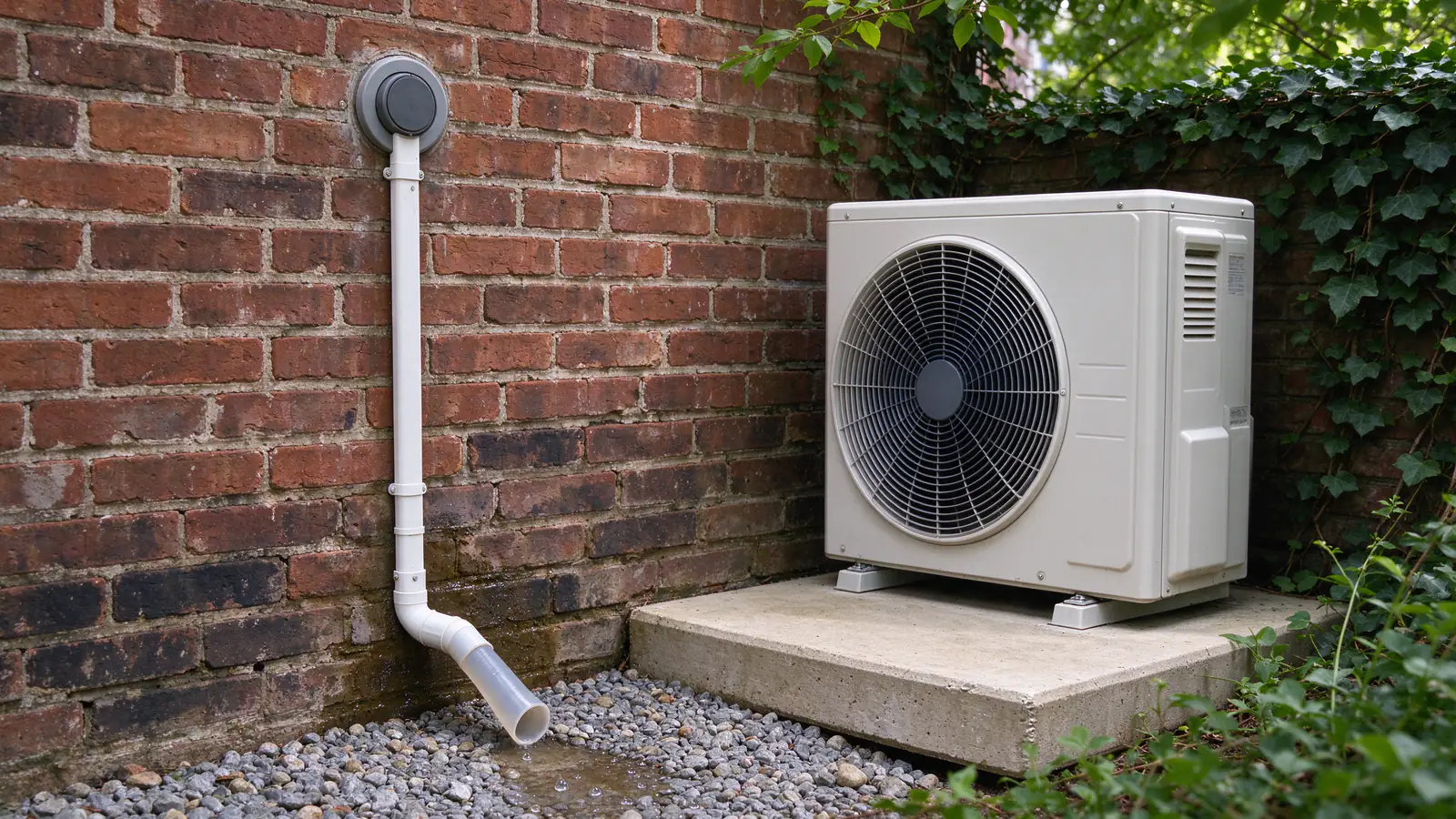
When a mini split cools, it pulls water out of the air, and that water has to leave the house. Roomwise DC Mini Splits plans a drain path for every head before it goes on the wall. Here’s where the water goes and what decides whether a head drains by gravity or needs a pump.
Where does the water come from?
The indoor coil runs colder than the room’s dew point, so moisture in the air condenses on it, the same way water beads on a cold glass. It drips into a pan under the coil and leaves through a drain hose.
DC makes this a real volume of water. July dew points at Reagan National average about 66°F, so a head running through a humid afternoon sends out a steady trickle, not a few drops. The dehumidification guide explains why that’s a feature, not a flaw.
How does the drain get out of the house?
On a wall head, the drain hose leaves the back of the unit and travels with the refrigerant lines and control cable through the same hole in the wall. From there it has three places to go.
| Where it ends | When it fits | What to watch |
|---|---|---|
| Outside, by gravity | The head is on or near an outside wall, above the ground outside | A steady fall all the way, and a good spot for the water |
| A house drain, by gravity | A plumbing drain sits below the head nearby | A proper connection with a trap or air gap, never an open cleanout |
| A condensate pump | The water can’t fall to its end: basements, inside walls, some ceilings | Power for the pump and a safety switch |
A cleanout plug isn’t a drain inlet. It’s an access point for clearing the sewer line, so we tie into a proper fitting instead.
Gravity or a pump: which does my head need?
Gravity, wherever the head can drain downhill to its end. It has no moving parts and nothing to fail but a clog.
Heads that drain by gravity
- A head high on an outside wall, with the drain leaving straight through it
- A head on an inside wall with a short, sloped run to an outside wall below it
- An upper-floor head whose drain can drop down a rear wall inside a line cover
Heads that need a pump
- A basement head below the level of the ground outside; see basement installation
- A head on an inside wall where the drain would have to climb to get out
- Most ceiling cassettes, which carry a built-in pump to lift water above the ceiling
- A floor console or ducted unit with no downhill path; the indoor unit types guide compares them
What makes a gravity drain reliable?
A steady downhill slope from the head to the end, with no low spots where water sits and no high spots it has to climb. A sag holds water, grows slime and eventually backs up into the pan.
The rest is detail that prevents leaks later:
- Insulation inside the house. A cold drain line sweats in a humid wall cavity.
- An open end. The end sits in open air, not buried in mulch or pushed into the soil.
- Protection outside. A line cover keeps sun and ladders off it.
- A level head. A head tilted back sends water away from the drain outlet and down the wall.
How does a condensate pump work?
A pump has a small reservoir with a float. When water reaches a set level, the pump runs for a few seconds and pushes it through a thin tube to a drain or outside, often uphill.
What a good pump setup includes
- A safety switch. We wire a float switch on every pump, so if the pump fails, cooling stops before the pan overflows.
- Power. The pump takes power from the head or its own supply.
- Access. It sits in a line cover, closet or ceiling where it can be reached.
Pumps wear out, and their reservoirs collect slime. Replacing a failed condensate pump typically costs $200 to $500.
Does the drain matter in winter?
The indoor head stays dry in heating mode, because its coil is warmer than the room. The outdoor unit takes over the job of making water.
In heating mode, the outdoor coil gathers frost, and the unit runs short defrost cycles that melt it. That water runs out of the base pan.
- Raise the unit. A stand or bracket lets meltwater drain away instead of freezing into a block under the unit.
- Clear the snow line. Washington averages about 10 days a year with an inch or more of snow on the ground.
- Keep it off paths. Meltwater on a walkway turns to ice overnight.
The winter guide covers defrost in more detail.
What keeps a drain from clogging?
Dust and slime. Air that gets past a dirty filter coats the coil, washes into the pan and feeds a film that grows in the warm, wet drain.
The routine that prevents it
- Rinse the head’s filters every few weeks in the cooling season.
- Book a professional cleaning about once a year, with the pan and drain flushed; see maintenance.
- Glance at the outside end of the drain each spring for insects, mud or a crushed line.
Clearing a blocked condensate drain typically costs $100 to $300. If water is already on the floor, the leaking water guide walks through the causes.
What goes into our drain plan
Every head in our written plan has its drain path drawn out: where the hose leaves, the slope it takes, where it ends, and whether it needs a pump.
At startup we pour water into each pan and watch it leave the far end. The installation process guide shows where that test sits in the day, and the placement guide explains how the head’s spot sets the drain route.