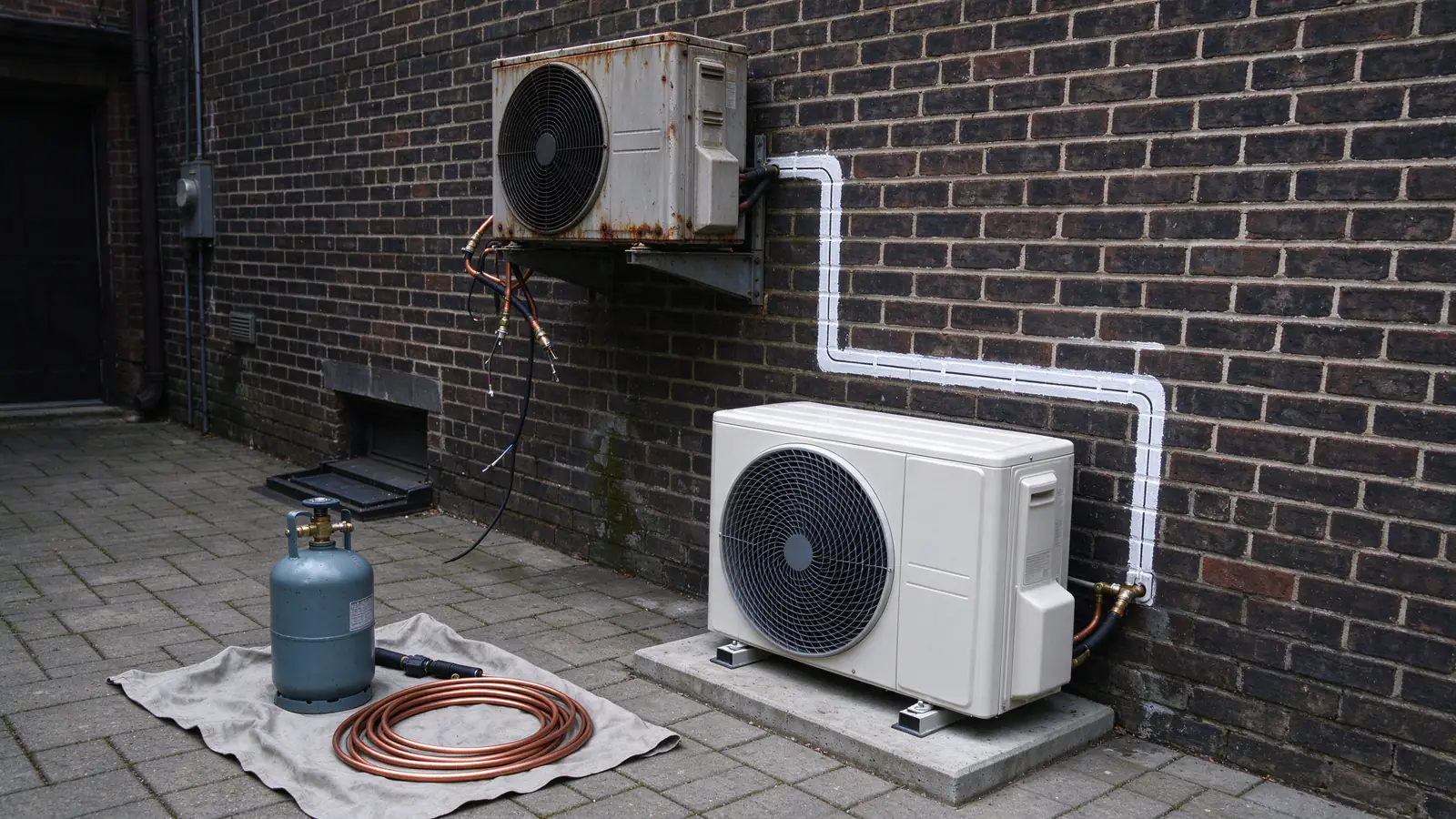
Roomwise DC Mini Splits replaces mini splits that have stopped earning their keep: the outdoor unit with a dead compressor, the system on an old refrigerant that no one stocks parts for, the head that leaks no matter how often the drain is cleared.
Replacement isn’t the same job as a new install. Half of what a mini split needs is already on the wall: the line set, the hole, the drain, the circuit and the bracket. The work is deciding which of those can stay, testing them properly and replacing the rest.
Repair or replace
Replace when the repair costs a large share of a new system, when parts or refrigerant for the model are hard to get, or when the system has never kept the room comfortable. Repair when one part failed on a system that otherwise works well.
Signs that point toward replacement
- A failed compressor on an older outdoor unit
- A refrigerant leak inside a coil, rather than at a flare joint that can be remade
- An older refrigerant whose supply is shrinking and getting costlier
- A unit that was the wrong size from the start and short cycles or can’t keep up
- Repeated repairs on the same system within a couple of seasons
If you aren’t sure which side you’re on, start with a repair diagnostic. That visit tells you what failed, and the answer often decides the question for you.
What can stay and what gets replaced
The pieces around the equipment each get their own check. Nothing is kept just because it’s already there.
| Part | We keep it when | We replace it when |
|---|---|---|
| Line set | It holds nitrogen pressure, matches the new unit’s sizes and length, and suits its refrigerant | It leaks, is the wrong size, is kinked or crushed, or carried acid from a burnout |
| Control cable | It’s the gauge and conductor count the new unit asks for, with no damage | The new system needs a different cable or the old one is cracked |
| Condensate drain | It drains freely with steady fall, or its pump works and is switched | It sags, clogs or its pump is failing |
| Circuit and breaker | The wire and breaker match the new unit’s nameplate | The new unit needs a different breaker or wire size |
| Bracket or pad | It’s solid, level and sized for the new unit | It’s rusted, loose or too small |
| Wall hole and line cover | They line up with the new head’s piping | The new head’s piping exits elsewhere |
How we test the old line set
Copper can look fine and still fail. The test, not a visual check, decides whether the line set stays.
- Recover the refrigerant from the old system into a recovery cylinder.
- Check the sizes of the liquid and suction lines against the new unit’s manual, along with the total length.
- Cut off the old flares and make new ones on the clean copper.
- Pressure-test with nitrogen and watch the gauge for any drop.
- Flush the lines where the old system’s oil or a burnout could leave contamination.
Many new mini splits run on newer refrigerants than the systems they replace. The manufacturer’s manual says whether an existing line set may carry them and what has to be done first. When a line set fails, we run a new one, often along the same route.
When a multi-zone system needs replacing
A multi-zone outdoor unit and its heads are one matched system. If the outdoor unit fails, the heads usually go with it, because older heads rarely pair with a current outdoor unit, and mixing makers isn’t possible.
That makes replacement a chance to fix the layout. A room that never felt right can get a different head type, and a head that served an empty room can go. Each line set is tested on its own; some may stay while others are replaced. The multi-zone install page covers the design side.
What a replacement costs
Roomwise’s typical range for a like-for-like single-zone replacement is $4,000 to $7,500. That’s the case where the line set passes the test, the circuit suits the new unit and the outdoor unit goes back on the same spot.
Roomwise’s typical range for a replacement that needs more work is $10,000 to $20,000. That covers new line sets, a new roof or facade mount, new wiring, or a condo board or historic review of the new unit.
Add-ons that move the price
- A new line set. If a line set can’t be reused, a new run typically adds $500 to $1,500, depending on its length and how it reaches the outdoor unit.
- Extra heads. Each additional indoor head on a multi-zone replacement typically adds $1,500 to $3,000, depending on the head type and whether its line set can be reused.
- Electrical changes where the new unit needs a different breaker or wire size
- A new pad, stand or bracket where the old one won’t carry the new unit
Your price comes from the site visit and arrives in a written estimate that lists each part we keep and each we replace. The cost guide and cost estimator show the drivers.
Sizing the new unit, not copying the old one
The old unit’s size is a starting point, not the answer. If the room was always too warm in August or clammy in June, the old unit may have been the wrong size, or the room may have changed since with new windows or insulation.
We run a heat-load calculation for each room the system serves, using the District’s design days of 21°F and 92°F. Sometimes the right replacement is smaller than the old unit. The sizing guide explains why bigger isn’t better.
The replacement day
The work runs in this order: recover the old refrigerant, remove the old equipment, set the new outdoor unit and heads, remake the connections, pressure-test, pull a deep vacuum, then release the refrigerant and start up.
What’s different from a new install
- Recovery first. The old refrigerant goes into a cylinder, not into the air.
- Fewer new holes. The head goes where the old one was if the piping lines up.
- A charge check. If the line set is longer than the new unit’s factory charge covers, we weigh in the extra refrigerant the manual calls for.
The installation process guide walks through each step.
Permit and rebate on a replacement
DC’s mechanical permit covers replacement of an air-conditioning system as well as new installs, so every replacement gets one. In a historic district, a new unit in a different spot may need Historic Preservation Office review. The permit guide has the steps.
DCSEU’s rebate requires new ENERGY STAR certified equipment, the DOB permit and the equipment paperwork, and where it qualifies we can take it off our invoice. Current amounts are in the rebates guide. When you’re ready, send us the model numbers.