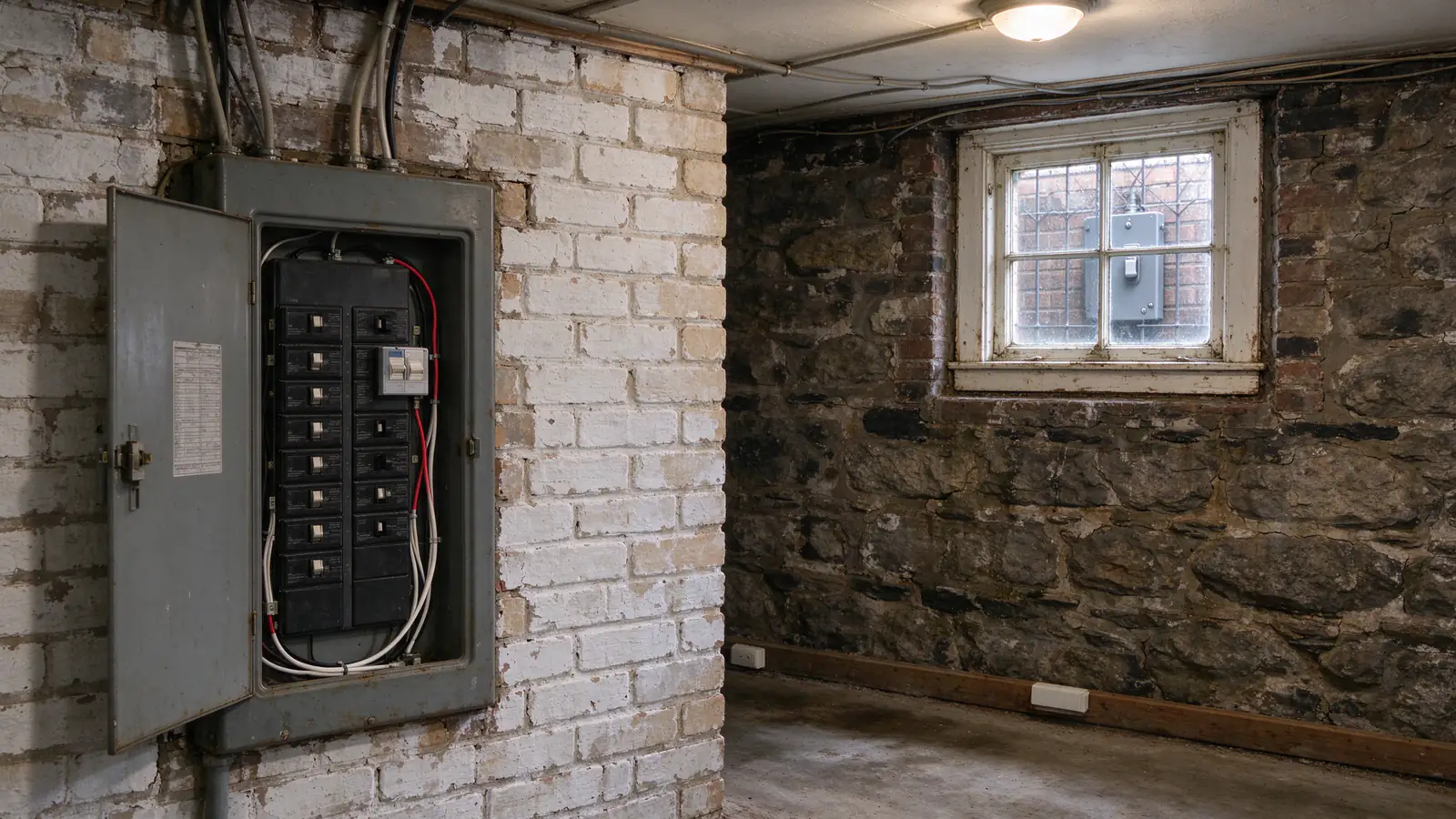
A mini split needs less power than central air, but it still needs a circuit of its own, and older DC panels are often full. Roomwise DC Mini Splits checks the panel on the first home visit, because it can change the plan and the price.
This guide covers what the electrical side involves and how to tell if your panel is ready. For the bigger picture in a radiator house, start with air conditioning for old houses.
Does a mini split need its own breaker?
Yes. Each outdoor unit runs on a dedicated circuit with its own breaker in the panel. Nothing else shares it.
On most ductless systems, that one circuit powers everything. The outdoor unit sends power and control signals to each indoor head through a four-wire cable that runs alongside the refrigerant lines. A few systems are different:
- Ducted air handlers sometimes take a separate supply; see ducted installation.
- Some brands and models power the indoor unit on its own circuit.
- Condensate pumps draw a little power from the head or a nearby outlet.
The installation manual for the exact equipment settles it, and the written plan shows each circuit.
What size breaker and wire does it need?
The outdoor unit’s nameplate decides. It lists a minimum circuit ampacity (MCA), which sets the wire size, and a maximum overcurrent protection (MOCP), which is the largest breaker or fuse allowed.
How the two numbers work together
| Nameplate figure | What it controls | The rule |
|---|---|---|
| Minimum circuit ampacity (MCA) | Wire size | The wire must carry at least this current |
| Maximum overcurrent protection (MOCP) | Breaker size | The breaker can’t be larger than this |
So a unit with an MCA of 13 amps and an MOCP of 20 amps can sit on a breaker up to 20 amps, with wire sized for the circuit. Guessing from the unit’s tonnage gets this wrong; reading the label gets it right.
Are mini splits 110 or 220 volts?
Most run on 208/230 volts, which takes a two-pole breaker and two spaces in the panel. Some small single-zone units come in a 115-volt version on a single-pole breaker.
The voltage doesn’t change efficiency much; the same unit moves the same heat either way. A 230-volt unit draws about half the current, so it uses smaller wire for the same power. A 115-volt model helps only where the panel has one open space and no room for a two-pole breaker. Every multi-zone outdoor unit runs on 208/230 volts.
Do I need a disconnect for a mini split?
Yes. The electrical code, at article 440, calls for a disconnecting means within sight of the outdoor unit and readily accessible. DC currently builds to the 2014 National Electrical Code.
The disconnect is a small weatherproof box beside the unit with a switch or pull-out block. It lets anyone servicing the unit cut power there, without walking to a basement panel and hoping the breaker is labeled right. Its feed and the short whip to the unit run in conduit or liquid-tight flexible conduit.
Can my panel handle a mini split?
That depends on two different limits: open spaces in the panel, and the capacity of the service coming into the house. A panel can have empty slots and still be near its limit, or be full and have capacity to spare.
What we look at on the visit
- The service size, on the main breaker or the meter
- Open spaces for a one-pole or two-pole breaker
- The big loads already on it: electric water heater, dryer, range, other air conditioning
- The panel’s condition, and whether it’s a model that can take new breakers
- Future plans, such as an electric range or a car charger, that share the same service
| What we find | What it means | What happens next |
|---|---|---|
| Spaces open, capacity to spare | The easy case | A new breaker and a run to the outdoor unit |
| No spaces, capacity to spare | The panel is crowded, not overloaded | Tandem breakers where the panel allows them, or a small subpanel |
| Little capacity left | The service is too small for the new load | A load calculation, then a heavy-up |
If you’re moving the whole house off gas, size the plan for every new electric load at once. A panel that can take one mini split may not take a heat pump water heater and an induction range too.
What is a heavy-up in DC?
A heavy-up raises the electrical service to the house, usually with a new panel and meter equipment. DOB’s instant heavy-up permit covers upgrading one existing service to a maximum of 200 amps.
That instant permit is issued only to licensed contractors, and it doesn’t cover a service or meter box placed in public space. Pepco has to be involved, since the service connection is theirs. Allow time for Pepco’s side when a heavy-up is part of the plan; the permit guide has the DOB side.
Are there rebates for the electrical work?
DCSEU lists electrification rebates for the electrical work a heat pump can need. Amounts can change during the program year, so check DCSEU’s current page.
- Heavy-up to 200 amps: up to $2,000
- New or upgraded circuits: $400 per circuit, up to three per home
DCSEU asks for photos of the panel before and after, the DOB permit and the inspection record. The rebates guide covers the heat pump rebate and how the programs fit together.
What about multi-zone and whole-house systems?
A multi-zone outdoor unit runs several heads from one circuit, so three rooms on one outdoor unit need one circuit. Three single-zone systems need three.
That’s one reason a multi-zone system suits a tight panel. On a whole-house plan with two or more outdoor units, the circuits add up, and the service size becomes the real question.
Is surge protection worth it?
It’s optional, and worth considering. Inverter mini splits run on circuit boards that don’t like voltage spikes from storms or the grid.
A surge protector at the disconnect or the panel costs little next to a board. A control board replacement typically runs $300 to $1,800, with inverter boards on some outdoor units at the top of that range. See repairs for how we diagnose a failed board.
How the electrical side affects price
Roomwise’s typical range for a standard single-zone install, $3,000 to $6,000, assumes the panel has room for the new circuit. A new circuit with panel work is one of the things that moves a job toward our complex range.
Your price comes from the site visit and a written estimate that lists the electrical work separately. The DC cost guide explains the other drivers, and the operating cost guide covers what the circuit will carry once it’s running.