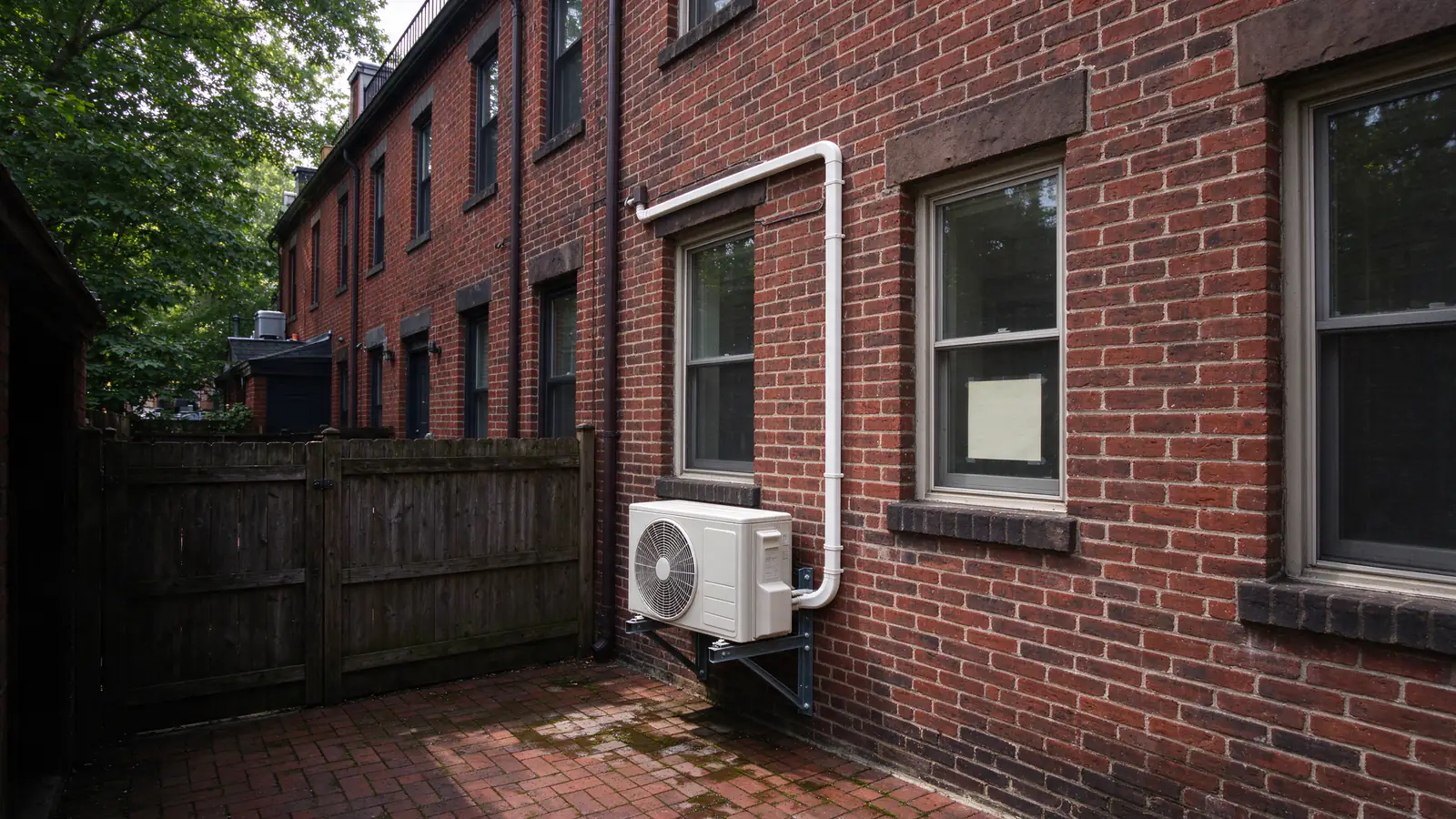
A mini split looks like an appliance, but in DC it’s mechanical work that needs a permit. Roomwise DC Mini Splits puts a DC Department of Buildings (DOB) mechanical permit on every install. This guide explains what that permit covers, what it costs, and what changes on a historic or condo property.
Does a mini split need a permit in DC?
Yes. DOB’s mechanical permit covers the installation, repair or replacement of any refrigeration or air conditioning system, and a mini split is both a heat pump and an air conditioner.
The one cooling device that needs nothing is a portable window unit. It plugs in, sits in a window and needs no permit or preservation review. Once you move to a mini split, the refrigerant lines, the wall opening and the outdoor unit all fall under the permit. The mini split vs window AC guide compares the two.
Which permits does a job need, and what do they cost?
Most single-zone jobs need one or two permits. The DOB fee for the mechanical permit is small next to the install price.
| Permit | When it applies | DOB fee |
|---|---|---|
| Mechanical (refrigeration and air conditioning, Class E, up to 120,000 BTU/h) | Every install or replacement | $50.60 per system |
| Electrical trade permit | A new circuit for the outdoor unit | Set by the DOB electrical schedule |
| Instant electrical heavy-up | Upgrading the service to a maximum of 200 amps | $64.90 |
| DDOT public space permit | Any work or equipment in public space | Set by DDOT |
Historic preservation review isn’t a separate permit. On a historic property it’s an extra step inside the building permit. The cost guide shows where the permit sits in a full estimate.
Who can pull the permit?
DOB issues trade permits, including mechanical and electrical, only to a DC master licensed professional. Its instant mechanical permit is issued only to licensed contractors.
That rule also links the permit to your rebate. DCSEU’s application asks for the DOB permit, and the contractor named on the rebate has to match the one on the permit. The rebates guide lists the rest of the paperwork.
What is an instant permit, and can my job use one?
DOB’s instant mechanical permit (it replaced the old postcard permit) is issued on the spot for small, standard jobs. It covers installing no more than one new air conditioning unit up to 10 tons, or repairing one existing unit.
Where it doesn’t apply
- Historic property. Instant permits can’t be used in a historic district or on a landmark. Those jobs go through preservation review.
- Bigger scopes. Work beyond one new unit goes through the standard permit route.
What changes on a historic property?
A lot of DC sits inside a historic district: Capitol Hill, Georgetown, Dupont Circle, Bloomingdale, Mount Pleasant and dozens more. There, the Historic Preservation Office (HPO) reviews the permit before DOB issues it.
How the review works
HPO lists heating, ventilating and air conditioning equipment as minor work, controlled mainly by keeping it out of view. More than 95% of applications get expedited clearance, often the same day. If HPO needs a visibility check, allow up to five business days. Interior work, like the head on your bedroom wall, isn’t subject to preservation review.
What HPO looks for
- Not on the front. The preservation board’s sustainability guide keeps mini splits off a primary elevation where they’d be prominently visible.
- Secondary walls are fine. Rear walls, rear yards and many roofs work, placed to keep street visibility low.
- Lines inside where possible. Conduit and line covers should run inside or on a secondary wall.
Georgetown adds one more layer. Under the Old Georgetown Act, the Commission of Fine Arts, through the Old Georgetown Board, reviews most exterior work visible from a street or alley. You still file through HPO. See our Georgetown, Capitol Hill and Bloomingdale pages for how this plays out on each street.
What if the outdoor unit sits near the sidewalk?
Then check where public space starts. DDOT counts everything between the property lines on a street as public space, including tree boxes and sidewalks, and it often includes what appears to be a front yard.
- Ground units: not allowed in a public space front or side yard as a matter of right. They’d need a Public Space Committee exception and would have to be easily removable.
- Any work in public space: needs a DDOT permit through its TOPS system.
In practice, a rear yard, rear wall or roof avoids all of this. The placement guide compares those spots.
Which code does the inspector use?
DC builds to the 2017 DC Construction Codes, which took effect May 29, 2020. They’re based on the 2015 International Mechanical Code and the 2014 National Electrical Code, amended for the District.
DOB is rewriting all twelve code categories, with final codes expected in late 2027. Until those take effect, the current codes apply. Two other rules shape a mini split in DC:
- Noise: mechanical equipment can’t exceed 60 dB(A) at the property line.
- Work hours: construction runs Monday to Saturday, 7am to 7pm, without an after-hours permit.
What about condos and co-ops?
A condo adds the building’s rules on top of DOB’s. DC’s Condominium Act bars an owner from changing the exterior appearance of the unit or the building unless the condominium documents allow it.
So in a condo, the board’s written approval for the outdoor unit and any wall opening comes before the permit. Our condo installation page covers the board approval step.
What happens if I skip the permit?
You lose more than you save. The mechanical permit fee is $50.60, and DCSEU’s rebate, worth $1,000 to $5,000 on its current form, needs the permit to pay out.
There’s also the house itself. An unpermitted system can come up when you sell or when an appraiser asks about the equipment. Getting the permit at the start costs far less than sorting it out later.
How the permit fits into our process
The permit is part of the job from the first visit. We check the address for historic district and public space issues when we look at the outdoor unit’s spot, and the written plan reflects any review.
Once the permit is in hand, a single-zone install takes about a day. The installation process guide walks through each step, and our single-zone installation page shows what’s included.