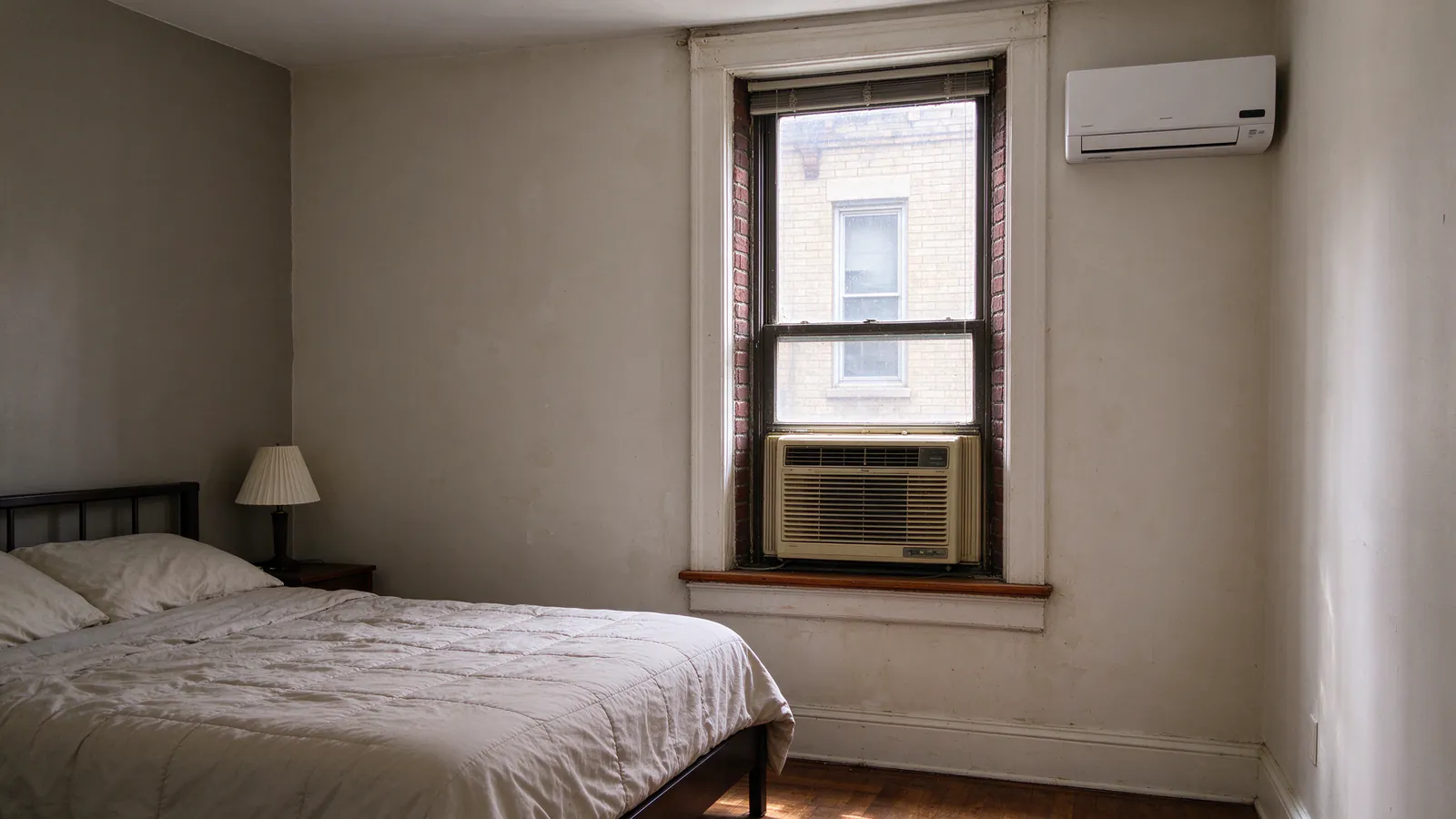
Every June, window units go back into sashes all over Washington, and every June someone asks whether this is the last year. Roomwise DC Mini Splits replaces window units with single-zone and multi-zone mini splits, and this guide lays out the trade so you can decide room by room.
Window units are still how much of DC cools
Window and wall units are the default in houses without ducts. About 30 percent of DC homes cool with individual units like these, according to the federal residential energy survey.
That makes sense for a city full of radiator houses. A window unit costs little, goes in on a Saturday and needs no permit. The trouble is what it asks of you every summer, and what it doesn’t do in winter.
How the two compare
A window unit wins on purchase price and simplicity. A mini split wins on almost everything you live with day to day, from noise to winter heat.
| Window unit | Mini split | |
|---|---|---|
| Where the compressor sits | In the window, in the room | Outside |
| Noise in the room | Compressor and fan | Fan only |
| Heats in winter | Most don’t | Yes, it’s a heat pump |
| The window | Blocked all season | Free to open, with light and a view |
| Speed control | Most switch on and off | Inverter slows down to match the room |
| Drafts and security | Gaps around the panels | A sealed hole about three inches across |
| Seasonal work | In each spring, out each fall | Filter rinses and a yearly cleaning |
| DC permit | None for a portable unit | DOB mechanical permit |
What you get back with a mini split
The obvious gain is the window. The bigger gains show up at night and in January.
Quiet sleep
The compressor is the loud part of any air conditioner. A window unit puts it a few feet from the bed. A mini split puts it outside, so the room hears a fan on low.
Heat in the same room
A mini split is a heat pump, so the head that cools in July heats in January. In a back bedroom at the end of the radiator run, that can be the bigger win. The winter guide explains how it holds up in DC’s cold snaps.
Drier air
Washington summers are humid. An inverter mini split runs long and slow, which keeps the coil cold and pulling water from the air. A window unit that cycles on and off leaves more moisture behind.
When a window unit still makes sense
A mini split isn’t the right call for every room. A window unit is a fair choice when the numbers or the timing don’t support an install.
- A room you use a few weeks a year, like a guest room
- A home you plan to leave soon, where the install won’t stay with you
- A room with no workable spot for an outdoor unit or line route
- A stopgap while you plan a larger whole-house job
Portable floor units with a window hose are another stopgap. They cool less for the power they use, since the hose and the window gap let warm air back in.
Running cost
A modern inverter mini split uses less electricity than an older fixed-speed window unit for the same cooling. How much less depends on the two units’ ratings and how you run them.
Two points decide the difference:
- Efficiency ratings. Compare the window unit’s rating with the mini split’s SEER2 and EER2.
- Hours of use. A bedroom cooled every night all summer saves more than a room used now and then.
The operating cost guide works through Pepco’s rates for both seasons.
What replacing a window unit involves
The job is a single-zone installation: one head, one outdoor unit and the lines between them. A single-zone install takes about a day once the permit is in hand.
The steps
- We visit, measure the room, check the panel and find the outdoor spot.
- You get a written plan with the head spot, line route, drain path and price.
- We pull the DC mechanical permit.
- We mount the head, run the lines, pressure-test and vacuum them, and start the system.
The window unit comes out, and the window is yours again. The installation process guide covers each step in more detail, and the placement guide covers where the outdoor unit can go.
What the switch costs
Roomwise’s typical range for a standard single-zone install is $3,000 to $6,000. That covers one room, a short line run and a panel with space for the new circuit.
A long line route, a roof or wall bracket, or panel work pushes the price up.
Your own price comes from a site visit and a written estimate. When you’re ready, book a visit.