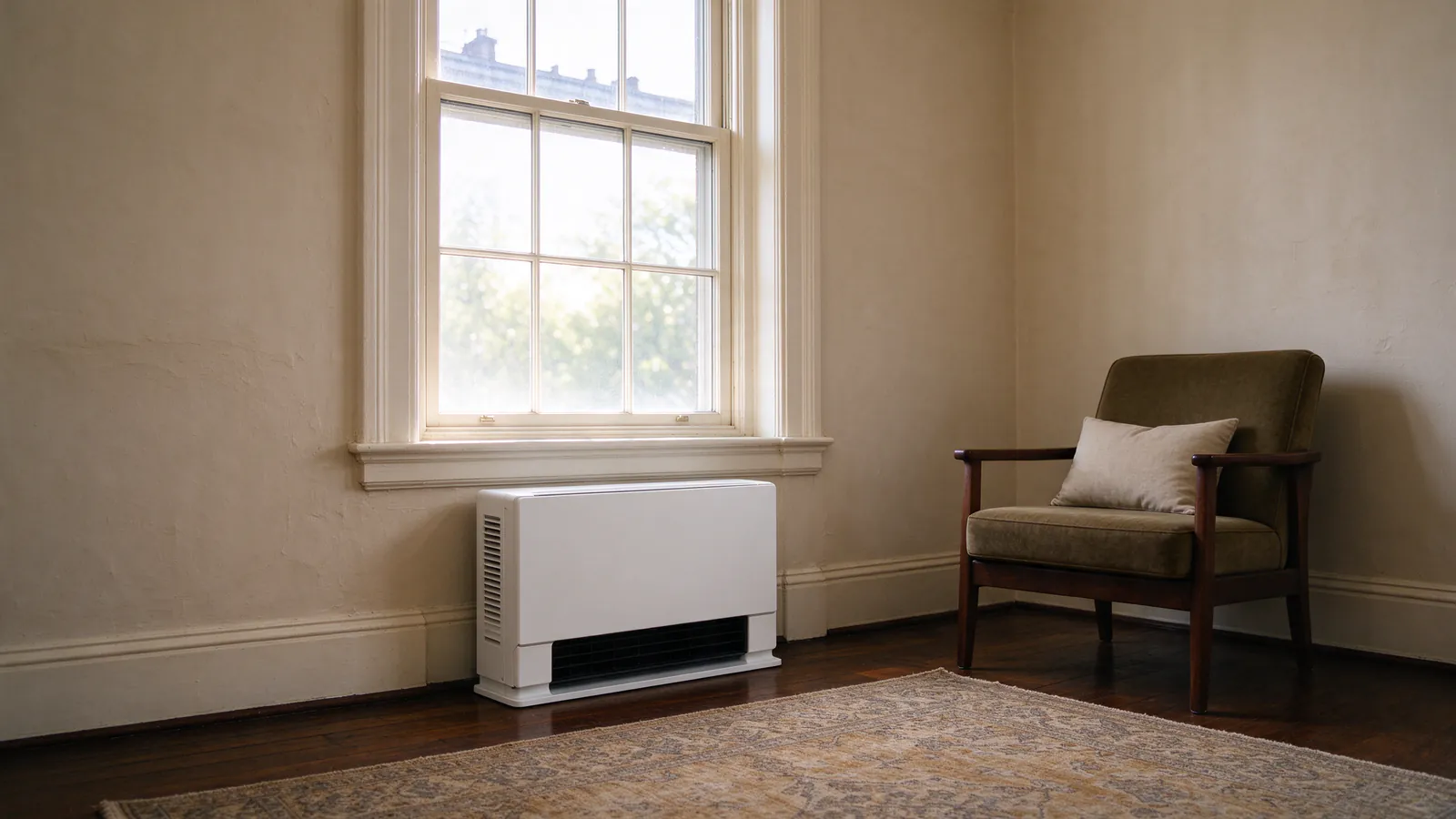
The outdoor unit decides capacity; the indoor unit decides how the room looks and how air moves through it. Roomwise DC Mini Splits plans every head type around the room it serves, and this guide shows where each one fits in an older DC house.
The four types at a glance
Each type moves air from a different spot in the room. That spot changes how the room heats and cools, where the drain goes, and how easy the unit is to clean.
| Wall head | Floor console | Ceiling cassette | Concealed ducted | |
|---|---|---|---|---|
| Where it sits | High on a wall | Low on a wall | Recessed in the ceiling | Closet, attic or soffit |
| Air throw | Across the room from above | Up the wall from below | Out in four directions | Through grilles, one or more rooms |
| What you see | The whole head | The whole console | A square grille panel | Supply and return grilles |
| Drain | Gravity or a pump | Gravity, easiest of the four | Built-in pump on many models | Gravity or a pump, at the unit |
| Space needed | A clear wall above head height | A clear wall below a window | Depth above the ceiling | A closet, attic or ceiling cavity |
| Install cost | Lowest | Higher | Higher | Highest |
Wall-mounted heads
A wall head is the default for most rooms. It mounts on a plate high on the wall, and its line set leaves through a hole behind it.
Where it works best
- On an outside wall, so the lines pass straight through to the outdoor unit
- High enough to throw air across the room, with the clearance the manufacturer’s manual sets above it
- Facing the room’s open space, not a bed or a desk
Where it struggles
- Long, narrow rooms, where air falls short before the far end
- Rooms with no clear wall above window height, which describes some parlors with tall windows and deep crown molding
Our single-zone installation page shows how a wall head is mounted.
Floor consoles
A floor console sits low on the wall, a few inches above the floor. Warm air comes out near your feet and rises, which suits heating.
Where it works best
- Under a tall window, where a radiator once stood
- Top-floor rooms with sloped ceilings, where there’s no high wall for a head
- Rooms where heat matters most, such as a cold rear bedroom
The drain falls easily from a console, since it sits low on an outside wall. The trade-off is floor space and a unit at furniture height, which can’t sit behind a sofa.
Ceiling cassettes
A cassette recesses into the ceiling, leaving a square grille that blows air in four directions. It spreads air evenly in a large or open room.
What it asks of the house
- Depth above the ceiling and a framing bay that can carry it
- A drain plan, since water forms above the room; many cassettes carry a built-in pump
- Access for cleaning, through the grille, which means a ladder
Cassettes suit basement ceilings, kitchens and open living areas. The ceiling cassette installation page covers the work in detail.
Concealed ducted units
A concealed ducted unit, sometimes called a slim duct unit, hides in a closet, attic, soffit or ceiling. Short ducts carry air to grilles in one room or a few small rooms.
Strengths and trade-offs
- Nothing visible but the grilles
- Several small rooms can share one unit, which helps where a head in each would be too big
- All rooms on the unit share one setting
- The filter needs an access panel, and someone has to open it every few weeks in season
The ducted mini split installation page covers where these fit, and the ducted vs ductless guide compares them with central systems.
Mixing types on one system
A multi-zone outdoor unit can run different kinds of heads, if the manufacturer lists that combination. A wall head in a bedroom, a console in the parlor and a cassette in the basement can share one outdoor unit.
Each head is still sized to its own room. The sizing guide explains how, and the zones guide helps count how many you need.
Controls for every type
Every type comes with a handheld remote. Most can also take a wired wall thermostat or a Wi-Fi controller.
Choosing a control
- Handheld remote: included, simple, easy to lose
- Wired wall control: a fixed spot, good for ducted units and cassettes out of reach
- Wi-Fi controller: lets you set rooms from your phone, useful for a basement apartment or a room you rarely visit
Whatever the type, the compressor is an inverter. It slows down to match the room instead of switching on and off, which keeps the temperature steady.
How the type changes the price
Wall heads cost least to install. Consoles, cassettes and concealed ducted units cost more, for ceiling or floor work, drain pumps, ductwork and access panels.
Your price comes from the site visit and a written estimate. The DC cost guide explains what moves it, and the condensate drain guide covers drain options for each type.